Democrats Need an AI Economic Agenda
Democrats need an AI economic agenda built around enforceable rights, individual bargaining power, small-business adoption and broadly shared growth.
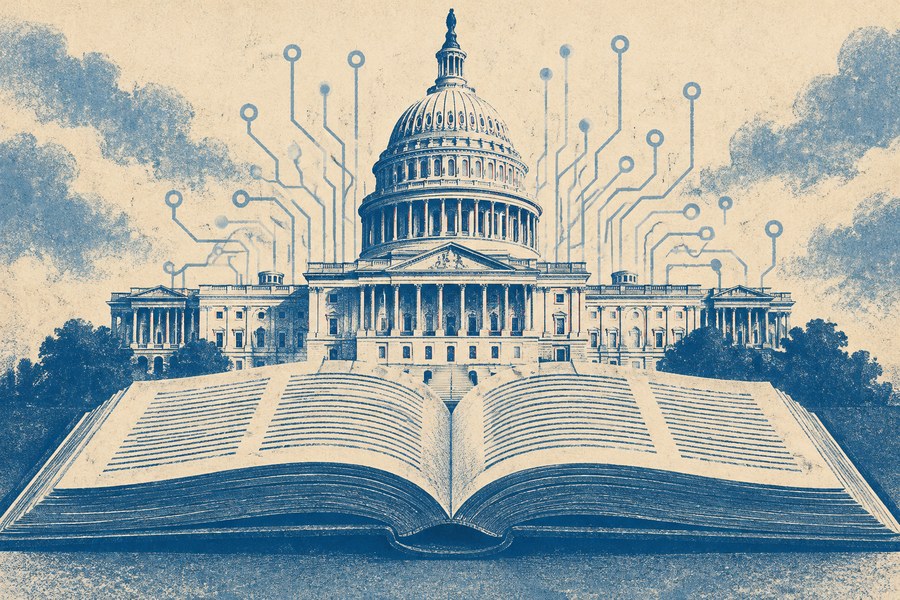
The Associated Press has called control of the next House and Senate for Democrats [1]. That gives them a new opportunity to shape the country's economic agenda, even with a Republican president. Election results tell a party who will have power. They do not, by themselves, tell it what to do with that power. Democrats need an economic argument that people can recognize in their own lives, and AI should be central to it.
As of the morning of November 5, the remaining uncertainty concerns the final margins, rather than which party will organize Congress. ABC News projects Jon Ossoff’s reelection; the Senate races in Alaska and Mississippi remain uncalled. Newsroom calls are distinct from certification: Georgia’s official reporting labels its counts unofficial.[7] The incoming Democratic majorities will still face a Republican president, so enacting an AI agenda will require negotiation. These results do not establish an AI electoral mandate. They create an opportunity—and an obligation—to explain how the technology can improve people’s economic position.
A warning to Democrats: as a lifelong Democrat, we cannot fall back into the habits of leadership in the past 10 years to reflexively become so investigation-oriented that we forget why we were elected as a party and what we have to do for the American people. An economic agenda should come first. Investigations should come second. They should happen where appropriate, but they cannot come at the expense of an economic agenda of prosperity for the American people.
An insurance decision. A job application. A power bill. A small business buying software it cannot meaningfully negotiate. These are places where people will encounter AI whether or not they choose to use a chatbot. A party that wants to govern should have an answer for what those systems owe them.
My answer is capitalist: enforceable rights, accountable businesses, open standards and competition. AI should give an ordinary person more leverage against a large institution, and give a small firm capabilities it could not previously afford. Public policy should help make that possible.
Give people something they can use
I have set out the detailed proposal in An AI Framework for America. Congress should establish rights when AI materially shapes consequential decisions: notice, real reasons, correction and human reconsideration. Those rights should survive the fine print.
Industry should then build technical standards inside the statute, with public oversight and a limited safe harbor for good practice. Businesses need a practical account of what compliance requires, and individuals need remedies when it fails.
People should also be able to use an agent that works for them. Someone negotiating a bill or comparing services should not have to rely entirely on the assistant owned by the company on the other side. Security matters, but it should not become a general permission for platforms to exclude competition.
This is an economic argument because it concerns information, access and bargaining power. A person who can challenge a consequential decision is in a stronger position. So is a business that can adopt AI without carrying the compliance budget of a large company.
Those are the gains the proposal is intended to produce. It still has to work in practice. Rights that people cannot exercise, certification that small firms cannot afford and standards controlled by incumbents would undermine the argument.
Growth has to reach people
I agree with Bernie Sanders on the central concern: AI's gains should not belong to a handful of owners while everyone else lives with the consequences. His arguments about concentrated power deserve a substantive answer.[2]
My route differs. I want to keep investment and development moving, with enforceable protections underneath them. Data centers should cover the power and grid costs they cause, disclose water use and operate within meaningful environmental limits. Those obligations should make building responsible and predictable.
I also support a recurring AI dividend without government ownership of the companies. Funding, eligibility and amount remain open questions. A dividend needs a credible design before anyone promises a check.
Productivity gains could also support a shorter workweek. I favor a temporary, refundable tax credit for employers that measurably reduce hours without cutting pay or benefits, with safeguards against shifting the same work into unpaid overtime. Small firms should be eligible to participate without a compulsory timetable.
On tax, I would start by inverting the ordinary income and capital gains rates. I am not prepared to support a wealth tax today. Whether I would consider one depends on how the AI framework and the broader national discussion develop, and on the design of the tax itself. State-level consideration would be a much later question, after those national efforts had been exhausted.
These proposals need separate scrutiny. The rights framework would not itself raise wages, and an AI agent is not a replacement for income security, education or an effective labor policy. Democrats should be clear about which instrument is supposed to do which job.
Who could make the argument
I would like to hear this agenda from leaders who can connect technology to ordinary economic life, including people outside the country's dominant technology hubs. Several Democrats have relevant records. I am suggesting possible messengers, not reporting endorsements or declared presidential campaigns.
Jon Ossoff has approached AI through its effects on consumers, including the use of automated systems to deny needed health care.[3] That is a useful starting point for a broader argument about what technology companies and the institutions using their systems owe people.
Mark Kelly has already put forward an AI economic agenda. His AI for America roadmap was released in 2025, and he introduced the Make AI Work for Americans Act in September 2026.[4] That work deserves credit. My framework makes additional choices about consumer rights, agent access, private technical standards and business contracts; it should be assessed alongside existing proposals.
Josh Shapiro's consumer-protection background offers another route into the argument. His administration's AI governance work and its lawsuit alleging that Character.AI chatbots misrepresented themselves as licensed physicians make accountability a concrete subject.[5] The allegations should remain identified as allegations, not treated as findings.
JB Pritzker can bring Illinois's experience with privacy and AI law to a national discussion.[6] A credible federal proposal has to answer what happens to protections states have already built. Asking states to accept preemption requires a serious account of the rights and enforcement that replace it.
The Democratic wins create an opening to advance this agenda in Congress. They do not establish that voters endorsed this framework. Each of these leaders would have to decide whether to adopt, change or reject it.
Make the bargain credible
The political bargain should be plain: people receive enforceable rights, businesses receive clearer obligations, and smaller firms receive a workable path to adoption.
Permanent federal preemption should arrive with the federal rights. A temporary bridge, if Congress chooses one, needs a narrow scope, preservation of existing protections, a valid constitutional design and a hard end date. The framework should stand even if that bridge never passes.
I want Democrats to lead, but I would welcome a sound bill from a Republican administration or a coalition in Congress. The point is to enact rules that people can use and businesses can trust. A party earns the argument by getting that design right.
For 2028, Democrats should be prepared to explain how AI will improve a household's position and a small business's prospects. Who can challenge a denial? Who controls the agent? Who pays for infrastructure? Who benefits when productivity rises?
Those questions deserve answers specific enough to legislate. That is the agenda I want Democrats to build.
Sources
Numbers in the text link here.
- Associated Press, congressional-control calls and outstanding races, November 4, 2026, via Spectrum News. Checked November 5, 2026. Open source (AP via Spectrum News) ↗
- Sanders, prepared remarks on AI, September 15, 2026. This is a source for his stated concerns, not an endorsement of this framework. The dividend, workweek-credit and tax positions above are my proposals. Open source (sanders.senate.gov) ↗
- Ossoff, Working to Crack Down on AI Improperly Denying Needed Health Care, July 14, 2026. Open source (ossoff.senate.gov) ↗
- Kelly, AI for America roadmap coverage, September 19, 2025; Kelly, bill introduction, September 24, 2026. Open source (kelly.senate.gov) ↗ Open source (kelly.senate.gov) ↗
- Pennsylvania Governor's Office, Character.AI lawsuit announcement, May 2026. Open source (pa.gov) ↗
- Illinois, Public Act 104-0538. Open source (ilga.gov) ↗
- Election status checked November 5, 2026, morning Eastern time: ABC News, Ossoff projection and live Senate results (updated 8:32 a.m.); Georgia Secretary of State, unofficial November 3 election reporting. Calls are newsroom determinations, not certifications; no final vote totals are asserted here.